

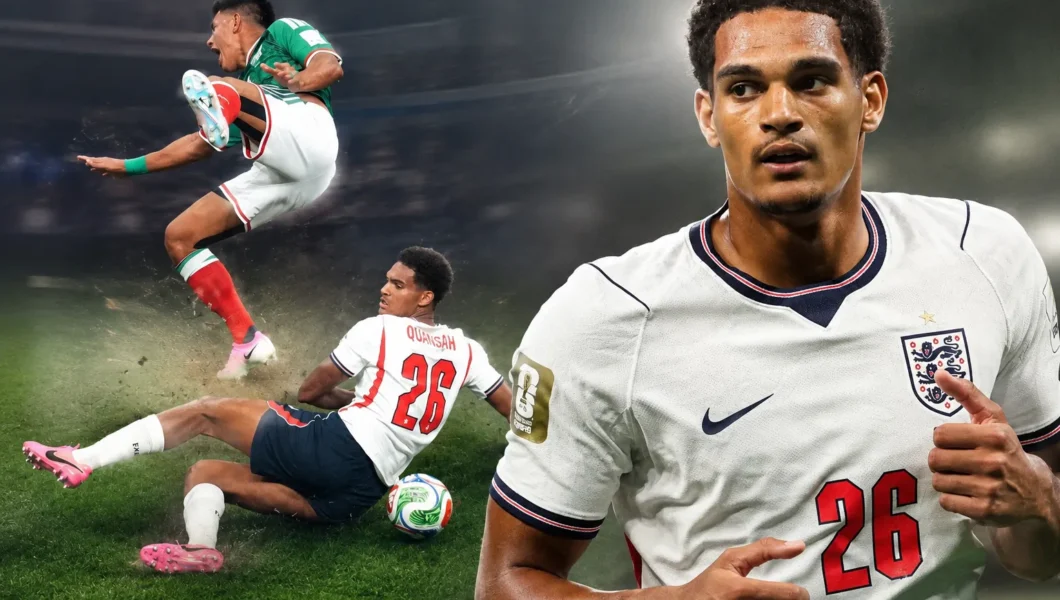
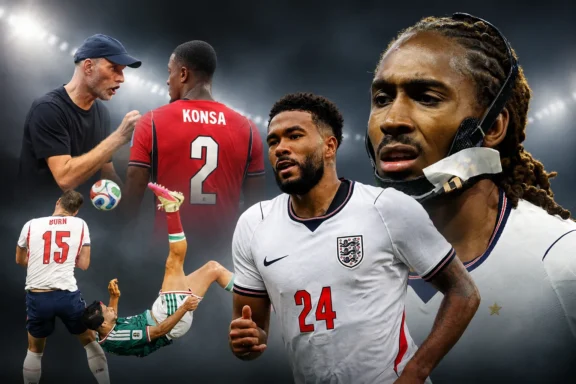
Quansah World Cup Ban has dealt England a major blow after Jarell Quansah received a two-match suspension from FIFA following his red card in England’s 3-2 last-16 win over Mexico on 5 July 2026. The Bayer Leverkusen defender will miss the quarter-final against Norway and a possible semi-final, leaving Thomas Tuchel’s already stretched squad with another significant selection problem.
England were in great spirits after beating Mexico at the Azteca Stadium. But just three days later, the mood in the camp changed completely. FIFA confirmed on Thursday 9 July that Quansah would serve a two-game ban. The decision has sparked a huge row about how FIFA handles discipline at this tournament.
The timing really could not be worse. Reece James is still working his way back from a hamstring problem. Marc Guéhi is in a race to get fit. Declan Rice has been struggling with illness. And now Quansah, who had done brilliantly in James’s absence, cannot play in the quarter-final against Norway or any semi-final after that. For a side with real hopes of winning the whole thing, losing a key defender for two knockout games hurts badly.
But the ban has also shone a light on something bigger. FIFA’s approach to discipline at this World Cup has been all over the place. In the days before the Quansah ruling, the governing body had already made one of the most talked-about decisions in World Cup history. The way FIFA treated Quansah compared to USA striker Folarin Balogun has left players, managers, and football associations across the world shaking their heads.
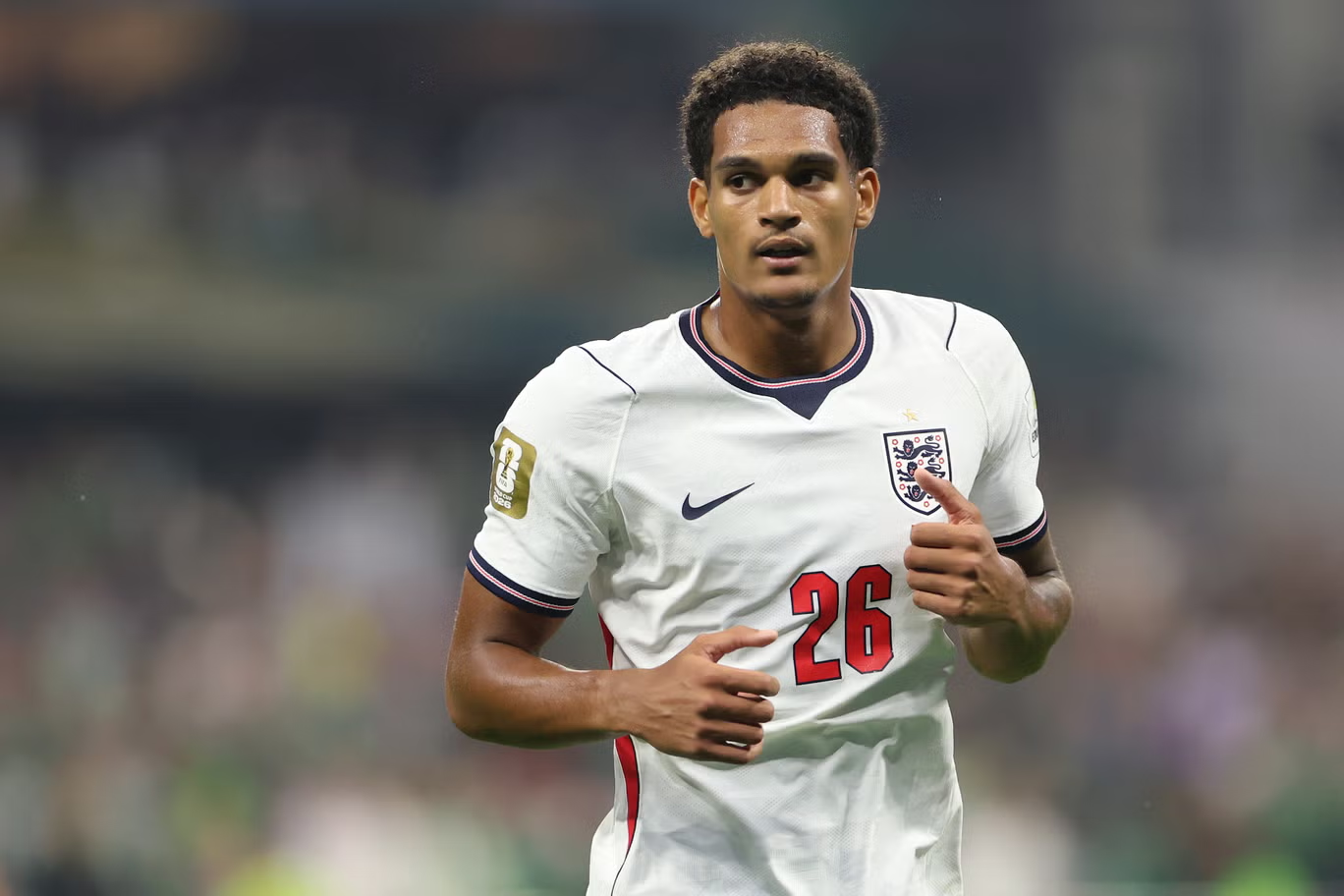
What Happened During England’s Win Over Mexico?
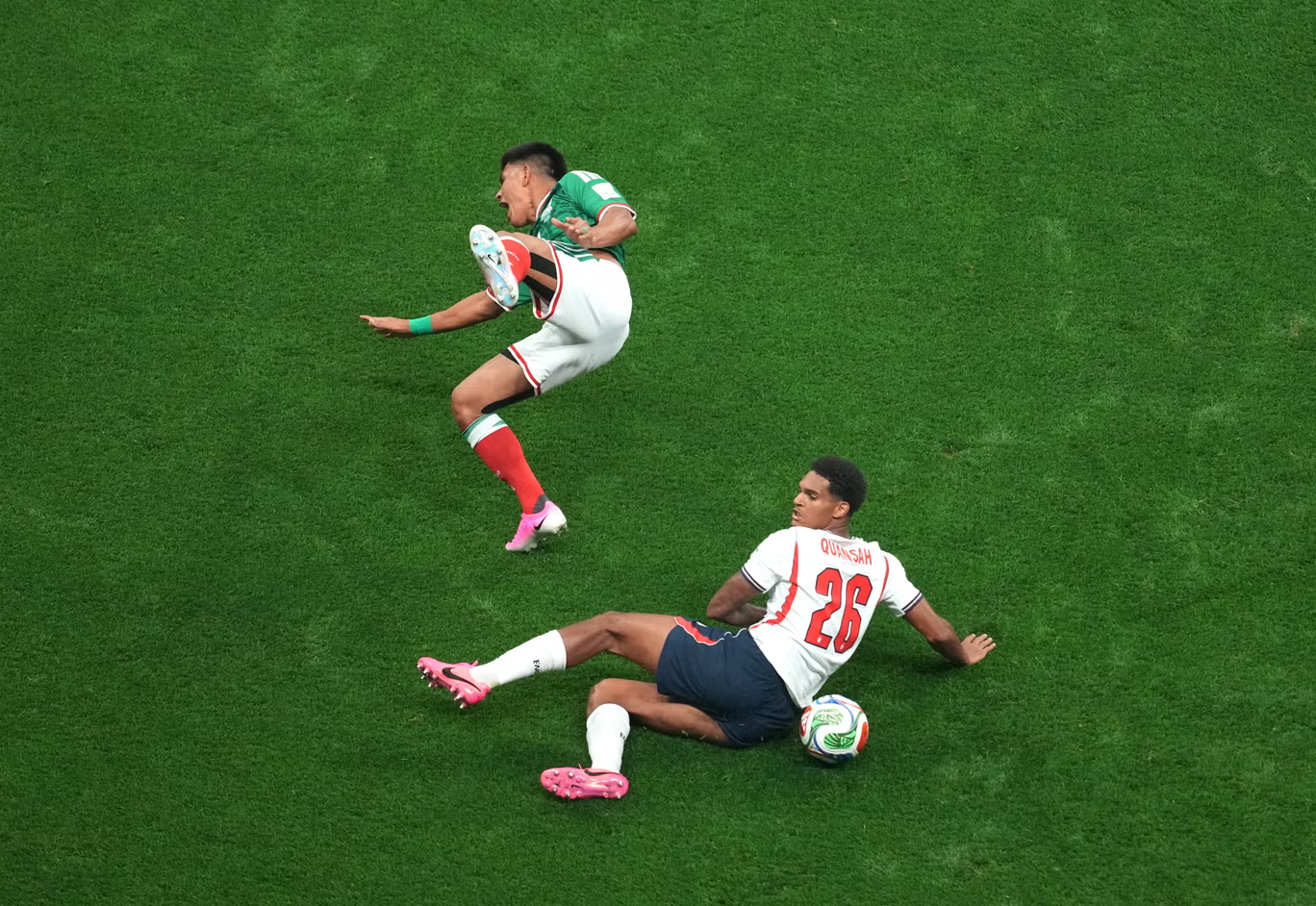
England’s 3-2 victory over Mexico on 5 July was tense and hard-fought, played out in front of a massive crowd at the Azteca Stadium. The Three Lions got through, but the night turned sour when Quansah was sent off in the 54th minute.
It happened when the Bayer Leverkusen defender stretched into a challenge on Mexico left-back Jesús Gallardo. At first, referee Alireza Faghani did not give a foul. But he was called to look at the pitchside monitor by the VAR team. After studying slow-motion replays, he changed his mind and showed Quansah a red card.
Tuchel was not happy at all. He was frustrated not just with the decision, but with the way VAR and freeze-frame replays can make a split-second challenge look much worse than it actually was. He had already said World Cup refereeing was “not good enough” after the match, and plenty of England fans and pundits agreed with him.
How Did FIFA Decide on a Two-Game Ban?
FIFA confirmed the two-game ban on Thursday, saying the challenge counted as serious foul play. Under normal FIFA rules, a red card at the World Cup means a one-game ban. But when a challenge is classed as serious foul play, the ban can be made longer.
In Quansah’s case, that classification doubled the suspension from one game to two. He had already shown great character by coming back from a knock picked up during the group-stage win over Panama. Now he has to watch from the stands at the most important point of the tournament.
The Football Association is understood to have raised concerns with FIFA about how the dismissal was handled, but the governing body has pressed ahead with the two-game ban regardless.
Which Games Will Quansah Miss?
Quansah’s suspension means he will not play in the following matches:
- Quarter-final: England vs. Norway, Miami, Saturday 12 July 2026
- Semi-final (if England qualify): A possible match against Argentina or Switzerland
Tuchel’s most obvious option at right-back is Djed Spence. He could also use Ezri Konsa there, which is what he did after Quansah went off against Mexico. But Tuchel has said he does not want to break up the partnership between Konsa and Guéhi at centre-back. With Guéhi carrying a hamstring problem, that might not be possible anyway.
Reece James is still an outside chance. He has not played since suffering a hamstring injury in the group stages against Ghana, but there are reports he could be involved against Norway, perhaps from the bench. Whether Tuchel would risk starting him is another question.
Bukayo Saka spoke well after the ban was confirmed: “I just found out. Very frustrating for sure, but it is what it is. We have to deal with it, adapt and get ready.” Nico O’Reilly was just as calm about it: “I’m gutted for him and he’s not happy about it, but the decision is made now and he’s got his head around it.”
The Balogun Controversy: How Trump Got Involved
To understand why so many people are angry about Quansah’s ban, you need to know what happened a few days earlier with USA striker Folarin Balogun.
Balogun, who has scored three goals at this World Cup, was sent off during America’s last-32 win over Bosnia and Herzegovina for a foul on defender Tarik Muharemovic. That red card meant an automatic one-game ban, so he would have missed the last-16 tie against Belgium.
Then Donald Trump stepped in.
The US president watched the incident, decided it was not a foul, and rang FIFA president Gianni Infantino to ask for a review. Speaking from the Oval Office, Trump said: “I relayed just that feeling. I didn’t tell him what to do. I can’t tell him what to do, but I think it was a committee that made the decision. And they made the right decision.”
FIFA used Article 27 of their disciplinary code, a rule that had never been used at a World Cup before. It gives FIFA the power to do whatever it thinks is right, without having to meet any specific conditions. Balogun’s one-game ban was suspended for 12 months. The red card itself was not taken away, as FIFA rules do not allow that. Instead, Balogun was treated as if he had received something like a sin-bin rather than a sending-off. He played against Belgium.
Belgium appealed, but FIFA threw it out almost straight away, telling the Belgian Football Federation they had “no standing in the case.” Bosnia, UEFA, Spain, and France all spoke out against the ruling. France then reportedly challenged Michael Olise’s yellow card from their win over Paraguay, which was exactly what people had feared: the Balogun decision had opened the door to endless appeals and outside pressure.
There is also a strange irony in all this. Balogun qualifies to play for the United States through birthright citizenship, which is the very policy Trump has spent years trying to get rid of. His mother, a Nigerian national, was visiting the US when she was too far along in her pregnancy to fly home. Trump has said nothing about that contradiction.
Tuchel’s Frustration and England’s Options
Tuchel was one of the loudest critics of the Balogun ruling, saying that FIFA’s handling of refereeing and discipline at this tournament has been simply not good enough. You can see why he is annoyed. His defender is now banned for two games for a challenge that most people would say was no worse than the one Balogun got away with.
The World Cup does not normally allow teams to appeal red cards. That has always been the rule, though Article 27 has now shown that it does not always have to be. The FA is thought to be looking at its options, but it is not clear whether an appeal will be made or what grounds it would be based on. What is clear is that the Balogun situation has changed the way teams think about discipline at this tournament. If a phone call to Infantino can get a ban lifted, why would any country not try the same thing?
Starmer Gets Dragged In
England’s World Cup has pulled in political figures from beyond the dressing room too. Prime Minister Keir Starmer found himself in the middle of a row over a scheduling dispute before the Mexico match.
FIFA had been looking at moving the England-Mexico kick-off time forward by six hours, from 6pm to noon local time, because of the threat of thunderstorms and concerns about fan safety. The Football Association asked Downing Street for help, and Starmer stepped in through official channels to oppose the change. FIFA eventually backed down after strong pushback.
The White House was quick to criticise. Andrew Giuliani, who is the executive director of the White House Task Force on the World Cup, told talkSPORT: “I would go and point to something I think is a much graver decision that was made just a couple days ago. Keir Starmer’s intervention through diplomatic channels of not allowing the Mexico-England match time to be moved. In the round of 32 after the match, three Mexicans died in this celebration. There were discussions about moving that match time from the evening to noon so that way you would have less risk of life to Mexicans. That’s far graver when you actually think about the consequences.”
Downing Street hit back, saying the Prime Minister “was supportive of representations made by the Football Association regarding the practical implications of a proposed scheduling change for the team’s preparations. The final decision on fixture timings remained a matter for FIFA.”
Starmer has been clear that, unlike Trump, he will not be ringing FIFA about Quansah’s ban. “I can’t tell you how many messages I’ve had to rescind the red card that we received in the early hours of Monday,” he said. “I hasten to add, I haven’t attempted to do that.”
What Does All This Mean for FIFA?
The real issue here is not just Quansah’s ban. A two-game suspension for serious foul play can be justified on its own. The problem is everything around it.
FIFA allowed a head of state to ring up and lobby for a ban to be overturned. It used a clause that had never been applied at a World Cup before. It then refused Belgium’s appeal by saying they had no right to challenge it, which is remarkable given that Belgium had just watched their opponents’ best player play after what should have been a ban.
Now Quansah sits out two games with no way to challenge the decision, while the rest of the football world asks a very simple question: what are the rules, and do they apply to everyone?
The 2026 World Cup has given us some brilliant football. England are in the last eight. Erling Haaland and Norway are waiting in Miami. But the off-pitch story, with political interference, confusing decisions, and a governing body that seems to make things up as it goes along, threatens to take over from everything happening on the pitch.
For Quansah and England, the focus now is simple. Keep winning so he gets the chance to play again.
FAQs
Quansah was sent off against Mexico for a reckless sliding tackle on Jesús Gallardo. FIFA classed it as serious foul play, which carries a bigger punishment than a normal red card. That is why his ban was set at two matches instead of one.
He will miss two games in total. That is a big blow, as both come at the sharp end of the tournament when England need every player fit and ready!
Quansah will miss the quarter-final against Norway in Miami. He will also miss any semi-final, which could be against Argentina or Switzerland. The only way he plays again is if England reach the final.
Just days before, USA striker Folarin Balogun had his one-match ban suspended after Donald Trump phoned FIFA to ask for a review. So while Balogun got to play, Quansah must serve his ban in full. Fans are asking a fair question: do the rules apply to everyone equally?
Losing a key defender for two knockout games is tough, especially with other players carrying knocks. But there is still hope! Tuchel has cover in Djed Spence and Ezri Konsa, and the team stays focused on going all the way.

No Comments