

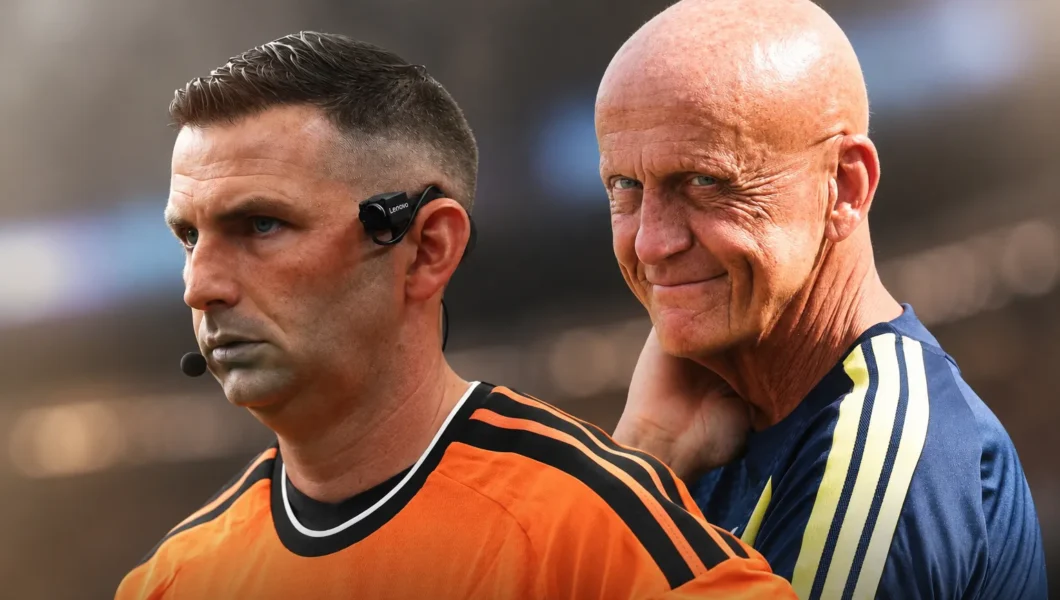
FIFA has a long-standing policy, rooted in the 1982 Falklands War, that stops English referees from officiating Argentina matches. Argentine officials are equally banned from taking charge of England games. At World Cup 2026, this rule could block Michael Oliver and Anthony Taylor from the final if Argentina are involved.
At a World Cup with 48 teams, 104 matches, and every major footballing nation going for glory, you’d think referee appointments would be the least controversial part of it all. You’d be wrong! Behind the scenes, FIFA’s refereeing operation is a quietly complicated machine. Geopolitical history, confederation politics, and decades-old conflicts all play a part in deciding who gets the whistle for the biggest games on earth.
The World Cup 2026 has brought this into sharp focus. One of England’s most respected referees, Michael Oliver, who is widely seen as a strong candidate for the final, may miss out. Not for anything he has done on the pitch, but for a war fought in the South Atlantic over 40 years ago. That’s the kind of story that makes you realise football is never just football.
So how does FIFA decide who referees what? Why are English officials kept away from Argentina matches? And is the Falklands War, 44 years on, really still having an effect on the biggest sporting event on the planet? Let’s take a look.

How Does FIFA Select World Cup Referees?
The process is much more thorough than most fans realise, and it starts a lot earlier than you might think. Pierluigi Collina is the chairman of FIFA’s Referees Committee. He’s also a former World Cup final referee himself, having taken charge of the famous 2002 final between Brazil and Germany. He says the monitoring process for each tournament begins almost as soon as the previous one ends.
“We began the process almost as soon as the 2018 World Cup ended,” Collina told ESPN ahead of the 2022 tournament in Qatar. “We monitored hundreds of match officials from around the world in each confederation. Our committee has members from every confederation and we tracked them throughout the process.”
That’s years of evaluation. Seminars, in-person assessments, and live match analysis all feed into a final list of selected officials. For the 2022 World Cup in Qatar, that meant 36 referees, 69 assistant referees, and 24 video match officials. World Cup 2026, with its bigger format, needs an even larger refereeing team.
The selection isn’t simply about picking the best referees and leaving it at that. If it were, the list would be heavily European. Most of the players at the World Cup ply their trade in Europe’s top leagues, and so do the continent’s best officials. But that’s exactly why FIFA doesn’t work that way.
Does Quality or Representation Come First?
“Our main criteria is quality,” Collina has said clearly. “Sure, there’s a neutrality to be respected. But the first priority is always quality.”
That said, global representation is built into the process. Officials are picked from every confederation, including UEFA, CONMEBOL, AFC, CAF, CONCACAF, and OFC. This makes sure the World Cup’s refereeing team reflects the global nature of the tournament, not just the strength of European football.
Once selected, all match officials stay in the same hotel and train together as a group. They receive detailed video packs on every team they might referee. They learn which players hold the ball, which ones make runs in behind, and which ones might make a reckless challenge in the final third. Collina says this kind of preparation is standard practice now. But when he was refereeing, he had to track down VHS tapes of matches to get ready for the 2002 final.
“I locked myself in my room for a day and a half, taking notes and watching every minute of every match,” he recalled. What was once down to individual effort is now standard practice across the whole group.
What Other Factors Shape Referee Appointments?
Beyond quality and representation, FIFA applies several neutrality rules to make sure no official has even the appearance of a conflict of interest. Here are the main ones:
The Home Nation Rule
No referee can take charge of a match involving their own country. This is the simplest rule and applies to everyone. Michael Oliver cannot referee England matches. An Argentine referee cannot officiate Argentina. That’s the starting point.
The Next-Match Consequence Rule
Referee assignments carry through into the next round. Once a referee has taken charge of a team’s match, their availability for that same team’s next game can be restricted. The aim is to stop any single official from building up a pattern of involvement with one nation across the tournament. Even if the referee is completely impartial, that kind of pattern can look like favouritism. FIFA avoids it wherever possible.
Confederation Neutrality
In big matches, FIFA usually avoids appointing a referee from a confederation with a direct interest in the result. You wouldn’t expect to see a South American referee in charge of a CONMEBOL final, for example. In the early rounds there’s more wiggle room, but as the tournament reaches the semi-finals and final, confederation neutrality becomes a major factor in who’s in the running.
Collina once explained that during Italy’s run at the 1998 World Cup, he was sent home as soon as his country reached the quarter-final. None of the referees in the last eight that year came from countries that had qualified.
The Geopolitical Factor
This is where things get really interesting, and where the Falklands War comes into it.
Is the Falklands War Still Shaping Referee Appointments in 2026?
Yes, it really is, and FIFA has never tried to hide it. The Falklands War of 1982 was a 74-day armed conflict between Britain and Argentina over the South Atlantic islands that Argentina calls the Islas Malvinas. It ended with Argentina’s surrender and the islands remaining under British administration. The war saw the loss of 255 British service personnel, 649 Argentine military personnel (most of them young conscripts), and three Falklands civilians.
The conflict ended on the battlefield. Diplomatically, it has never fully been resolved. And FIFA, perhaps more than many fans realise, has factored that tension into its officiating policy ever since.
The Ban: What It Means in Practice
FIFA has a long-standing ban on English referees taking charge of Argentina matches. The rule works both ways. Argentine officials are equally barred from refereeing England games. It’s a mutual arrangement designed to make sure geopolitical tensions between the two countries can never be seen to influence decisions on the pitch.
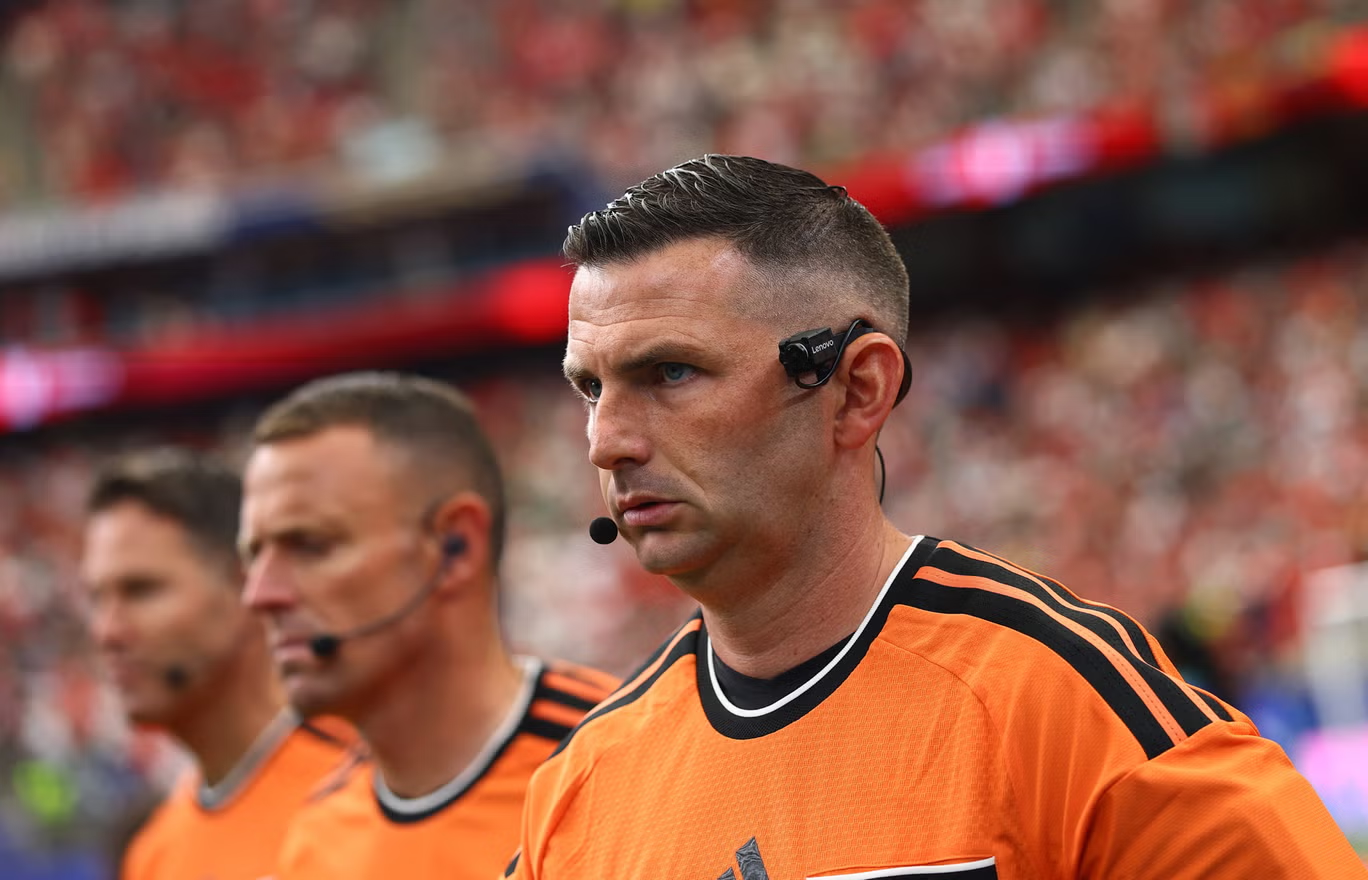
At World Cup 2026, both Michael Oliver and Anthony Taylor have been selected as England’s two centre referees. Oliver is widely seen as the stronger candidate for the final. He was given a high-profile appointment to take charge of Spain vs Belgium in the quarter-finals, which keeps him firmly in the running for the later rounds. But his route to the final could be cut off at any point, depending entirely on the draw.
If Argentina reach the final, Oliver is automatically ruled out. If England reach the final, he’s ruled out for a different reason, as a referee cannot officiate his own nation’s match. The only way either English referee could take charge of the World Cup 2026 final is if both England and Argentina go out before that stage.
The same situation came up at the 2022 World Cup in Qatar. Anthony Taylor was in strong form and was considered a real candidate for the final, until Argentina reached it. He was removed from consideration. The Falklands ban had done its work again.
The ‘Muchachos’ and Malvinas Controversy
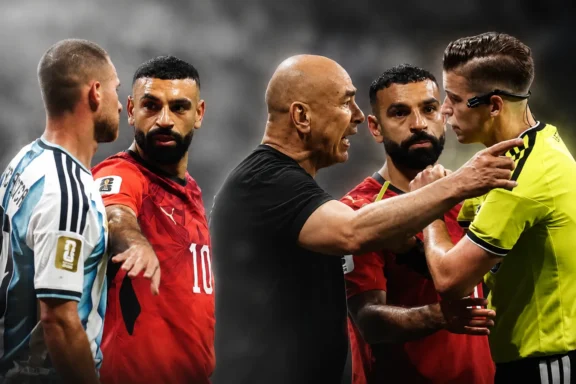
If there was any doubt about how raw this tension still is, Argentina’s players gave a pretty clear reminder during World Cup 2026. After a dramatic comeback win over Egypt, recovering from 2-0 down to win 3-2 in injury time, footage appeared of Argentina players singing in the dressing room. The lyrics referenced the Islas Malvinas.
The video featured well-known Premier League players including Enzo Fernandez (Chelsea), Emi Martinez (Aston Villa), Alexis Mac Allister (Liverpool), and Lisandro Martinez (Manchester United). It spread quickly online after Argentina’s official social media account posted it with English subtitles.
The chant came from the “Muchachos” anthem, Argentina’s unofficial World Cup song that first went viral after their 2022 triumph in Qatar. The song is based on a 2003 track by La Mosca Tsé-Tsé, reworked following Diego Maradona’s death. It includes a line that translates to: “I’ll never forget the young kids of the Falkland Islands.” Lionel Messi had publicly said it was one of his favourite songs.
FIFA said it would not take action against Argentina over the chant. The British government, for its part, was clear in its response: “Sovereignty rests with the UK, and the Islands’ right to self-determination is paramount.”
Whether it was deliberately provocative or simply part of the team’s culture, the moment showed just how unresolved and emotionally charged the England vs Argentina situation remains. It makes FIFA’s ongoing officiating policy look less like excessive caution and more like a sensible response to a genuinely sensitive situation.
Are There Any Exceptions to the Rule?
The policy hasn’t always been applied with total rigidity. One of the most notable examples is the 2006 FIFA World Cup in Germany, where Argentine referee Horacio Elizondo was appointed to take charge of the England vs Portugal quarter-final. That was a match involving England, the very nation that Argentine referees are supposedly not allowed to officiate.
Elizondo, born on 4 November 1963, is one of the most respected referees in the history of the game. He is the only official ever to have refereed both the opening match and the final of the same World Cup, which he did at Germany 2006. That speaks to the enormous trust FIFA placed in him. He retired from international refereeing in December 2006.
His appointment to an England match, despite being Argentine, shows that the rule has historically been applied with some degree of flexibility rather than as a total ban in every circumstance. The key factor seems to be whether a match directly puts an English referee in charge of Argentina, or an Argentine referee in charge of England, rather than a broader restriction on either nation’s officials.
Whether that same flexibility would be used today, in a far more connected and scrutinised environment, is quite another question.
The Bigger Picture: Politics Has Always Lived in Football’s Details
It might seem surprising that a 44-year-old war is still affecting referee appointments at the world’s biggest football tournament. But geopolitics and football have always been linked, even when the sport prefers to say otherwise.
FIFA’s referee selection process is built around performance. It uses careful monitoring, detailed video analysis, and years of evaluation. But it doesn’t exist outside the real world. When two nations share a history that includes armed conflict and unresolved territorial claims, and when that history is still being sung in dressing rooms during live tournaments, it’s hard to argue that a referee’s nationality is simply irrelevant.
Pierluigi Collina has built a process that genuinely puts quality first. That’s a real improvement from the old days, when appointments were often made based on FIFA power politics rather than refereeing ability. Under his leadership, the committee has also made history by appointing women referees to men’s World Cup matches for the first time, back in 2022.
But even a reformed, merit-based system has to work within the real world. And in the real world, England vs Argentina, whether on the pitch or in the officials’ room, carries a weight that no amount of neutral procedure can completely remove.
Will the Falklands Rule Matter When It Really Counts?
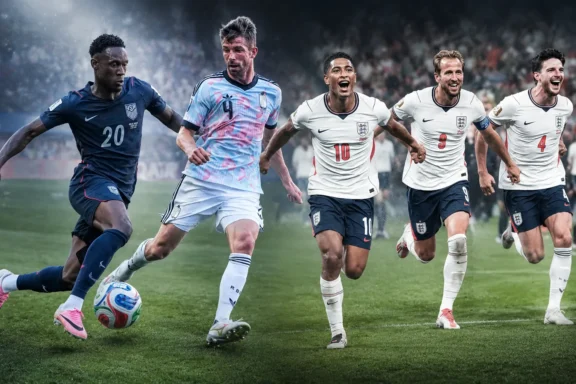
With England facing Norway and Argentina set to play Switzerland in the quarter-finals of World Cup 2026, a potential England vs Argentina semi-final on 15 July in Atlanta is very much a possibility. If both sides go through, the Falklands ban applies straight away. No English referee can take charge of that match, regardless of how well they’ve performed throughout the tournament.
It’s a strange thing to think about. Michael Oliver’s chances of refereeing a World Cup final could ultimately be decided not by anything he does on the pitch, but by events that happened decades before he ever picked up a whistle. That’s not a criticism of FIFA’s approach. There are genuine and understandable reasons why the policy exists. It’s simply a reminder that football, for all its universality, carries history with it wherever it goes.
FAQs
FIFA has a long-standing policy that stops English referees from taking charge of Argentina matches, and the other way round too. The policy goes back to the 1982 Falklands War between Britain and Argentina. It works both ways, so Argentine officials are equally banned from refereeing England games.
Michael Oliver and Anthony Taylor are the two English centre referees selected for World Cup 2026. Oliver was appointed to the Spain vs Belgium quarter-final.
Oliver could referee the final, but only if both England and Argentina are knocked out before that stage. If Argentina reach the final, he is ruled out by the Falklands ban. If England reach the final, he cannot officiate his own nation’s match.
Pierluigi Collina is the chairman of FIFA’s Referees Committee. He oversees the selection and appointment of all match officials at FIFA tournaments, including the World Cup. He is a former referee who took charge of the 2002 World Cup final between Brazil and Germany.
Yes. At the 2006 FIFA World Cup in Germany, Argentine referee Horacio Elizondo took charge of the England vs Portugal quarter-final. Elizondo is the only referee to have officiated both the opening match and the final of the same World Cup.
“Muchachos” is an Argentine football anthem, adapted from a 2003 song by La Mosca Tsé-Tsé and reworked after Diego Maradona’s death in 2020. The song includes a line referencing Argentine soldiers who died in the Falklands War. After Argentina’s win over Egypt at World Cup 2026, players were filmed singing a version of the chant that mentioned the Malvinas (Falkland Islands). FIFA said it would not take action against Argentina over the incident.
According to Collina, quality is the main criterion. Confederation representation and neutrality rules also apply, but the starting point is always the referee’s level of performance, assessed through years of monitoring.


No Comments